-
×
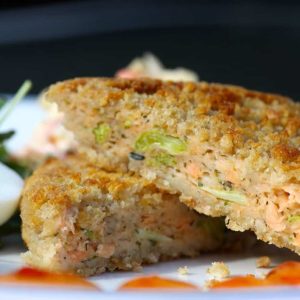
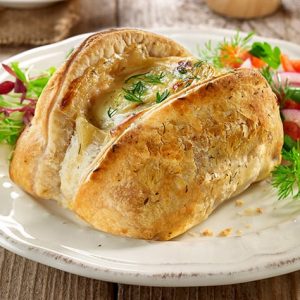 Salmon en Croute - Salmon in puff pastry x 4
1 × £19.95
Salmon en Croute - Salmon in puff pastry x 4
1 × £19.95
Subtotal: £19.95

FOR SALES AND ADVICE 01942 609647
Salmon en Croute - Salmon in puff pastry x 4
1 × £19.95 Subtotal: £19.95
Salmon is our most popular frozen fish and it’s easy to see why — it’s rich in omega-3, high in protein, naturally filling, and works with almost anything. We stock a range of frozen salmon to suit different tastes and budgets, from sustainably farmed Scottish fillets to wild caught sockeye salmon from the Pacific. Every portion is individually quick frozen (IQF) and vacuum-sealed, so you can take exactly what you need from the freezer with zero waste.
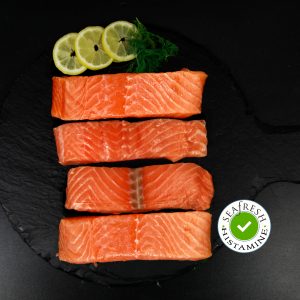
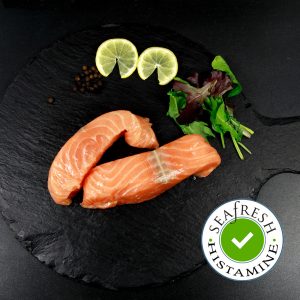
All of our frozen salmon fillets are centre-cut portions, meaning you get the thick, even part of the fish rather than tapered tail pieces. This matters because a consistent thickness means the fillet cooks evenly — no burnt thin ends and raw middles. Each fillet is skinless and boneless unless stated otherwise, and weighs between 140–170g.
We carry several types of frozen salmon, each with its own character:
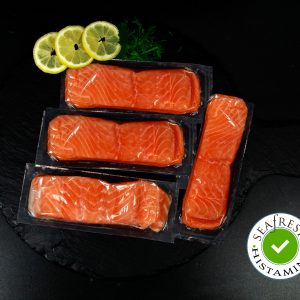
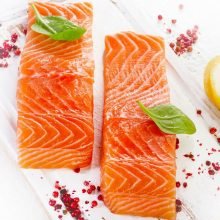
Scottish Salmon Fillets — Our best seller. Farmed sustainably in Scotland, these fillets have a rich pink colour, a buttery flake, and a mild flavour that works with everything from a simple lemon and butter bake to a teriyaki glaze. Available in standard and certified organic options. These are frozen extremely quickly after processing, making them suitable for customers with histamine intolerance.
Wild Sockeye Salmon — Caught in the cold waters of the Pacific, wild sockeye has a deep red colour and a firmer, more intense flavour than farmed salmon. It’s naturally leaner with a higher concentration of omega-3 fatty acids. Sockeye is prized by people who want a more robust salmon flavour and a denser texture. Our wild sockeye salmon fillets are individually vacuum-packed and frozen at sea.
Wild Salmon Fillets — For those who prefer wild caught salmon over farmed, our wild salmon offers a different eating experience. The flesh is firmer, the flavour is more complex, and the fat content is lower. Wild salmon tends to have a deeper colour than farmed fish due to its natural diet of krill and shrimp in the open ocean.
Marinated Salmon — Ready-to-cook options including lemon and dill, teriyaki, and other seasonal marinades. Perfect for a quick mid-week meal straight from the freezer.
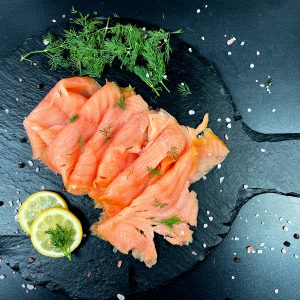
Smoked Salmon — We also carry smoked salmon in our smoked fish range, including both hot-smoked and cold-smoked options.
Showing all 11 results
This is probably the question we get asked most. The honest answer is that both can be excellent — it depends on what you’re looking for.
Farmed Scottish salmon is our most popular option. Modern Scottish salmon farms operate at sea in natural tidal environments with strict standards around feed quality, stocking density, and water cleanliness. There are no antibiotics, no artificial colours, and no preservatives in any of the farmed salmon we sell. Farming is also the most sustainable way to source salmon — the Marine Conservation Society (MCS) lists Wild Atlantic Salmon as a species to avoid because stocks are under pressure, which makes responsibly farmed salmon the better environmental choice for most buyers.
Wild caught salmon, particularly wild sockeye salmon from the Pacific, is a different product entirely. It has a deeper red colour, a leaner texture, and a more pronounced flavour. Wild sockeye is not on the MCS endangered list — Pacific sockeye fisheries are well-managed and sustainable. The trade-off is price: wild salmon is more expensive than farmed, and it can take two to three days to reach freezing after catch (compared to hours for our farmed salmon), which is worth knowing if histamine levels are a concern for you.
For histamine intolerance, our farmed Scottish salmon fillets are the safest choice. They’re frozen at extremely cold temperatures very quickly after processing, which halts histamine formation at the lowest possible level. Our wild salmon is still a good option but the slightly longer time to freezing means histamine levels may be marginally higher.
This sounds counterintuitive, but it’s true. Our frozen salmon is locked in at peak freshness the moment it’s frozen — no bacteria can form, no histamine can build, and nothing breaks down from that point on. When you defrost it, you’re eating fish that’s been preserved at the exact moment of peak quality.
So-called “fresh” salmon on a fishmonger counter or supermarket shelf may have been several days since processing before you buy it. During that time, quality deteriorates — subtly at first, then noticeably. The texture softens, histamine levels rise, and the bright colour dulls. Unless you’re buying directly from a fishing boat, frozen salmon that was processed and frozen within hours will almost always be fresher than the fresh alternative.
All of our frozen salmon can be cooked straight from frozen — no defrosting needed.
Preheat your oven to 180°C. Place the frozen salmon fillet in an oven-proof dish or on a sheet of foil. Add a knob of butter, a squeeze of lemon juice, and seasoning. If using foil, fold it into a loose parcel so the salmon steams inside — this keeps it beautifully moist. Bake for 25–30 minutes until the salmon is opaque in the centre and flakes easily. If you prefer a slightly browned top, leave the foil open and cook in the oven-proof dish instead.
For pan-frying, defrost the salmon first — either for two to three hours at room temperature or overnight in the fridge. Heat a knob of butter and a tablespoon of olive oil in a pan over medium heat. Cook for four to five minutes per side, turning occasionally. Add seasoning and fresh herbs during cooking. Skin-on fillets should go skin-side down first to crisp the skin.
Set your air fryer to 180°C. Cook frozen salmon fillets for 12–15 minutes, no oil needed. The air fryer gives a lightly crisp exterior while keeping the inside moist and flaky. For marinated salmon, reduce to 10–12 minutes as the glaze can catch.
Hollandaise is the classic — rich, buttery, and luxurious. Dill sauce is another natural pairing (where cod goes with parsley sauce, salmon goes with dill). A simple teriyaki glaze, a squeeze of lemon with capers, or a creamy mustard sauce all work beautifully. For something different, try a miso glaze on wild sockeye — the umami complements the stronger flavour of wild salmon perfectly.
Salmon is one of the most nutritionally complete foods you can eat. A 150g portion of our frozen salmon provides approximately 30g of protein and is one of the richest natural sources of omega-3 fatty acids (EPA and DHA), which support heart health, brain function, and joint mobility. The NHS recommends eating at least one portion of oily fish per week, and salmon is the easiest way to meet that target.
Salmon is also high in vitamin D (important for bone health and immune function — and something most people in the UK are deficient in during winter months), B12 for energy and nerve function, and selenium for thyroid health. The distinctive pink-to-red colour comes from astaxanthin, a powerful antioxidant that wild salmon get from their natural diet of krill and shrimp. Farmed salmon get it from their feed, which is why responsibly farmed salmon still has excellent levels.
If you’re looking for a leaner, lower-fat fish with similar protein content, our frozen cod or frozen haddock are great alternatives. For another oily fish high in omega-3 at a lower price point, try our frozen mackerel.
Our frozen salmon keeps for up to 12 months at -18°C or below in its original vacuum-sealed packaging. Once defrosted, treat as fresh and use within 24 hours. Do not refreeze salmon that has been fully defrosted at room temperature. If your delivery arrives partially defrosted but still cold to the touch, it’s perfectly safe to put it straight back in the freezer.
It depends on what you’re after. For everyday cooking, our Scottish farmed salmon fillets are our best seller — they’re consistently excellent quality, great value, and the safest option for histamine intolerance. For a more intense flavour and firmer texture, wild sockeye salmon is the premium choice. Both are individually quick frozen and vacuum-sealed.
Yes. All of our frozen salmon fillets can be cooked straight from frozen. Oven baking at 180°C in a foil parcel for 25–30 minutes is the easiest method. Air frying from frozen at 180°C for 12–15 minutes also works perfectly.
Sockeye is a species of Pacific salmon known for its deep red flesh, firm texture, and rich flavour. Unlike Atlantic salmon which is predominantly farmed, sockeye is wild caught in sustainably managed Pacific fisheries. It has a stronger, more complex taste than farmed salmon and is naturally leaner with higher omega-3 concentration. Our wild sockeye salmon fillets are frozen at sea and vacuum-packed.
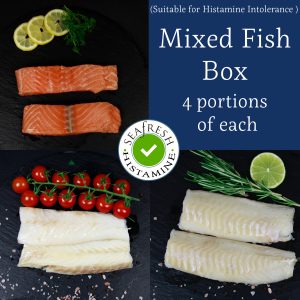
Yes — particularly our farmed Scottish salmon, which is frozen at extremely cold temperatures very quickly after processing. This halts histamine formation immediately. Our wild salmon is also a good option, though the slightly longer time from catch to freezing means histamine levels may be marginally higher. Look for the green tick icon on product images to identify our verified low-histamine products.
Neither is categorically better — they’re different products. Wild caught salmon (especially sockeye) has a deeper colour, firmer texture, leaner profile, and more intense flavour. Farmed Scottish salmon is milder, more buttery, consistently available, and more affordable. For sustainability, responsibly farmed salmon is often the better choice, as Wild Atlantic Salmon stocks are under pressure. We stock both so you can choose based on your preference.
Our farmed salmon comes from certified Scottish farms operating in natural tidal sea environments. Our wild sockeye salmon is caught in sustainably managed Pacific fisheries. All sourcing follows the Marine Conservation Society’s Good Fish Guide, and every fillet is fully traceable.
© Seafresh 2026